Excerpt from the 1976 publication of “Keeping Our Heritage Finland, Minnesota 1895-1976”.
This publication is available for purchase at the Gift Shop at the Finland Minnesota Heritage Site.
The Finns were late in coming to America. The first wave of immigrants came from 1880 to 1900. The second wave arrived after 1900, continuing until after 1920.
Early Finnish society was completely agrarian. People were content to remain on their land, or estate, which passed on from generation to generation. Following a crop failure and the great famine in 1867-68, a remarkable reshaping of Finnish society took place. People began wandering from their homes in search of bread and subsistence. This weakened the bonds tying everyone to his native village or his inherited domicile. Under these circumstances it was quite natural to head for areas of possible work in such places as sawmills, railroad construction sites, and the growing cities, especially Helsinki.
These people became known as the landless citizenry who had little hope of acquiring land in Finland. They migrated to the cities and from there to America. As the first immigrants to America found work for wages much higher than in Europe, they sent letters to friends and relatives in Finland telling of their good fortune. This encouraged others to Immigrate to America. Many found work in the copper mines of northern Michigan and later in the iron mines of Minnesota.
But the Finns were basically farmers. All had dreams of acquiring land. There was land available in America for those willing to work. Most were hard working people, but few had the money needed to buy land in the plains, with its rich dark soil. Free homestead lands were available only in Minnesota at the time, and even there, only in the more barren and northern regions. The nature of this northern region of Minnesota was so similar to that of Finland, and they knew how to clear the land and grow crops on it. They had the only initial capital required for this task: their own might and main. For this reason the Finnish immigrant chose to settle down, for the most part, in northern Minnesota.
In 1899, Tsar Nicholas II wanted to integrate Finland into the Russian empire. Part of this plan was to conscript the young men of Finland into the Russian Army. Many of the young Finnish men fled to America to avoid this conscription. They were usually taken into the homes of relatives and friends who helped them find work. Thus the Finnish population in America grew.
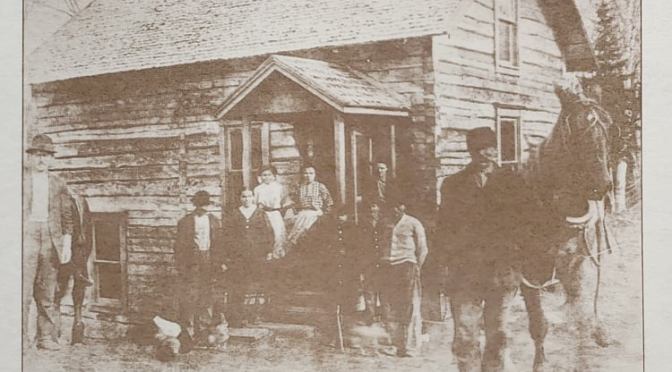
Finnish immigrants began to settle the area of what is now Finland, Minnesota in 1895, with a few Swedish and Norwegians. The largest influx of immigrants came between 1902 and 1906. Most of them came by boat to Little Marais or Kennedys Landing and walked inland, carrying their possessions on their backs. In order to establish homestead rights they had to live on the land they chose, so some brought families with them and others sent for their families after they built houses.
When a homesteader found a tract of land he liked, he would file for homestead rights. He had five years to “prove up” his ownership. He had to build a house and barn, clear a certain amount of land, and seed it. Most worked out (logging, building roads, etc.), but had to spend a certain amount of time on the land. They would post a list on the door of dates spent there. They had to advertise in a newspaper that they were homesteading a certain piece of land.
Most of the first homes were one room log cabins. Some used animal skins to cover the floors. Until the roads were made and they got horses, everything had to be carried in by packsack from the lakeshore. All provisions came by boat. There were no roads in this area, only the dog sled trails along the lakeshore. Meat and fish were no problem. Coffee, sugar, salt, flour, etc. had to be brought in.
In later years hunting licenses were sold, but in the early years it was not necessary. The first hunting license cost 25¢ and you could take one bull, one cow and one calf moose; five deer; and all the fish you wanted.
The first schools started in 1905. Due to lack of transportation and roads several schools dotted the area for many years. Five children were necessary to start a school. Some schools had children from only one family and in some cases the older sister was the teacher.
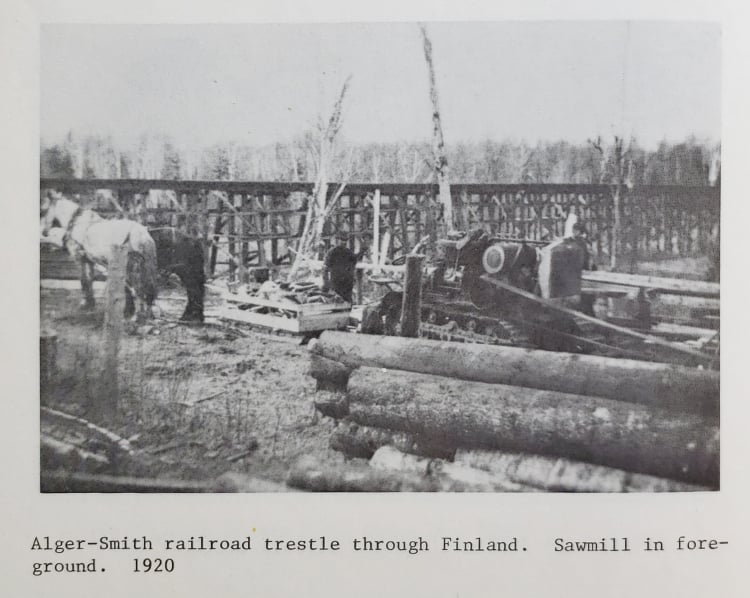
In 1907 the Alger-Smith Company built their railroad through Finland. It was 99 miles long, from Knife River to Cramer and into Cook County, with branches to Echo, Wanless and Wilson Lakes. Railroads registered as 99 miles long. If it went over 100 miles long the taxes were higher. Although the railroad was built for their logging operations, they carried passengers for 1½¢ a mile. The railroad went past Beck’s Store so they were going to paint “Beck’s Landing” on the station house. Beck talked to some of the other settlers and asked them to call it “Finland”, since most of the settlers were from Finland, Europe. This is how the community got its name. There was also a landing at the site of the present Recreation Hall. This was called Kents Landing. Even after the railroad was gone the locals still called it Kent, until 1933 when it became the CCC Camp. The trestle from the railroad across the Baptism River extended from the school to the Cramer Road, forming a wide curve. After the railroad shut down, the children used to play on the trestle. After the rails were removed, about 1922, the Alger-Smith Company sold the trestle to Andrew Sonju for $1.00 (it was on Sonju’s property). Sonju hired Victor Sampson with his sawmill to saw the trestle timbers into lumber.

During the heavy logging the white pine and cedar went to Duluth to be sawed into lumber; balsam and spruce to Ashland, Wisconsin for pulp; and tamarack was used for railroad ties. Many uncontrolled fires resulted from careless burning of slash. Most of the area was burned over in 1908, 1909, and 1910, and port ions were again burnt in 1923 and 1926.
From Cramer, the Alger-Smith railroad ran to Cascade River. There were six bridges in two miles over the Temperance River. The largest timber was nine miles out of Knife River. Ralph Anderson of Knife River remembers getting stuck in the tunnel. They had to work three hours to get through. Once old engine Nineteener’s tire split off the wheel and the engine had to be pushed by hand. The wheel had to be put back on with heat. You got $2.50 a day for watching the engine to keep the steam up. The Engineer got $5.00 a day. The engine was hand fired so someone had to stay up all night to keep it filled.
Excerpts from a diary of a fire warden (Alfred Fenstad) in 1912.
His diary would start trom the time he left the house until the time he returned. He certainly got his share of exercise. He would walk to Maple, then to Finland and back to Little Marais. Other days he would walk along the lakeshore. Sometimes he would ride the train, but he always had to walk a good portion of the trip. He advised the sawmill operators and settlers on what to burn and the best place and time. On June 18, 1912 he walked to the site of the present Air Base and back from Little Marais to check if it was a good site for a fire tower. He decided it was. It was later built there and moved further down the hill when the Air Base came. He mentions that one day he only walked six miles as it was the 4th of July.
In 1913 a Co-op Store was built west of Finland (site of the Roger Steele residence). In 1914, land was rented from Manttari and the store building was moved into Finland, by the bridge where the road to Little Marais used to be. A warehouse was built and later they bought a truck and drove it to Duluth for groceries each week. In 1930 land was purchased and a new store built at the present location.
Before the bus, mail came by sailboat or steamship. All mail came addressed to Crystal Bay. The Post Office was near Mattson’s. In the winter it came by dogsled. John Beargrease hauled mail by dogsled from Two Harbors to Grand Marais. He died in 1910. Later Oscar Beckman brought the mail by open stage from Two Harbors to Grand Marais, through Finland. When the trains were running, it came by train from Knife River.
About 1920 the Greyhound lines started bus service from Two Harbors to Grand Marais. They came to Silver Creek, along old Highway #1, through Finland and up through Cramer to Schroeder. When the lakeshore road was completed east from Little Marais, the route was changed to the Little Marais Road (County Road #6).
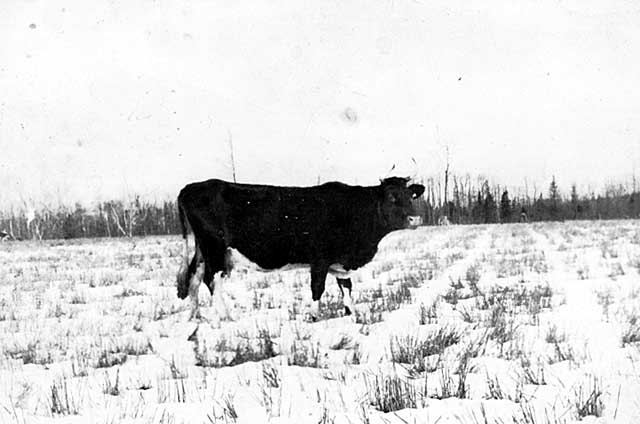
According to a study made of this area in 1934, there were 40 active farms. The clearings were mostly in hay, but oats, barley, potatoes and other vegetables and berries were also grown. Farms had from one to six cows. Cream was the only product shipped out. At one time the total schools enrollment in the area was 75. In 1934 they were consolidated into one school and the enrollment was 29. Most families supplemented their income through seasonal employment at lake resorts, road work, forest fire fighting, trapping, and hunting.
In the study made of this area, it was pictured as “an isolated, poverty stricken area, with primitive living conditions and severely limited educational opportunities.” A commission appointed by the Governor recommended that the State acquire all unoccupied land and encourage the population to move elsewhere. Luckily Professor Davis did not go along with this line of thought. He said that the present inhabitants are much better off on the average, than they would be in one of the larger cities.” How right he was! I don’t know of anyone going cold or hungry here in the depression years. Some of us never realized we were “poor and underprivileged”. After growing up and hearing our city relatives tell us about the depression (parents going to bed hungry so the children had enough food, etc.) we realize how lucky we were.
In 1935, according to the Geographical Review, there were 179 Finnish families with a total of 329 acres of hay and 165 acres cleared for crops. The chief crops were barley, oats and potatoes. Most families also had family gardens, strawberries, cows and pigs, for their own use.
The State’s long range plans for this area are stated in “A Quarter-Century of Change in the Finland Community of Northeastern Minnesota”. This calls for removing all the people from this area and relocating them in the southern part of the State. Much unnecessary economic hardship has been caused by the State not allowing any new companies to locate in this area. Further hardship will be caused if Reserve is forced close. The State is still trying desperately to force the people of this area out of their homes. New data found shows they are still trying to do this. They want to close all the resorts on the lake shore and have one or two big government owned resorts with the people who own their own resorts being forced to leave or else work for the State. Does this sound like democracy at work?
On February 21, 1935, the new bridge was finished across the Baptism River in Finland. At this time the road to Ely was changed so it went across the bridge, to its present location, instead of going by the Hakkarainen farm.
In 1939 the Co-operative Light and Power Association of Lake County started building the power line to Beaver Bay, Little Marais, and Finland. On December 29, 1939, the power was connected to Ed Shaffer’s business place, the residences of Wayne Haveri, Edwin Nikula, Joe Stevens and Wayne Tikkanen. The next day John Haveri, Ted Simington and William Tikkanen were connected to power. On January 8, 1940, the school and Gunnar Palm received power. By the end of February, most of the people from the lakeshore to Finland had power. This was a great help to everyone, especially the business places. It meant the end of cutting and hauling ice for the summer months. Refrigerators were probably the first major items to be bought. It was several years before all the side roads got electricity.
Gunnar Palm was the first director from our district for the Co-op Light and Power. He served from 1941 to 1946, and served as President, Vice President, and Secretary. Other directors were Ben Fenstad, Frank Metzinger, Robert Nelson, and, presently, Jim Branca.
In 1950 the Air Base on the hill went into operation. The fire tower was moved further down the hill to its present location. This increased the population, and the next year Reserve Mining Company started operation in Silver Bay, which also brought more people into the area. McGraw Construction Company came about 1947 to clear for the railroad for Reserve Mining Company (E. W. Davis Works). Many local men were employed there. They stayed at a boys camp on the Stoney River.
When construction of the Silver Bay Plant and townsite were begun in 1951, many local men worked for the construction company (Hunkin-Arundel-Dixon). After the plant began production in 1955, it became the major source of employment for the people in the area. When Erie Mining Company started production, it became the other major employer for the residents of Finland.
Due to these two companies, many young people who would otherwise have been forced to leave the area, have been able to work and live where they want to. If the State succeeds in closing Reserve, Erie will not last long under State pressure to close, and then the State will have won in their efforts to remove us from our homes. Every other company that has attempted to locate in this area has been stymied by State pressure and has located in central and southern Minnesota, or out of the state completely. The loser, if the State succeeds in their test case of their power, will be the people of the area, and ultimately, the people of the State. The winner will be: the foreign taconite companies that are already gearing up to fill the gap; and the State Government officials who need to win their case, regardless of evidence, to prove they can control the people of this area.
When the State did not think this area worth much, they put no State monies or opportunities into the area, but the people stayed and persevered. Now the State has decided our homes would make a good vacation area for the rest of the State and want to kick us out. Suddenly we are incompetent to manage our own land, land we have lived on for decades without Government help. Now that no other part of the State is in such good shape, they want to take it over and mismanage it the way the rest of the State land is being mismanaged. They have already taken over many places on the lakeshore, only four streams still have private land adjoining them; and, under the guise of the Costal Zone Program (on an inland lake) plan to close Reserve, force people to move, and clear a back-packing trail from Duluth to the Canadian border.
We have had many businesses, clubs, etc. in the area over the years. These are written up elsewhere in the book.
Random thoughts from the past:
-We had no electricity so we didn’t have all the labor saving devices we now have, so why did we have more spare time? We would walk several miles to visit neighbors, now we hardly have time to see the ones next door.
-No one locked their doors at night or even when they went away.
-Children who walked to the store for groceries were invited into Mrs. Lehto’s kitchen for a bowl of cornflakes and milk, and usually left with a bag of candy which hadn’t been on their order.
-The lady who had cookies locked in a chest so she would have something on hand for unexpected company, otherwise her boys would eat them all.
-Looking at pictures through a stereoscope. hidden in the woods.
-Finding bootlegger’s whiskey jugs
-The Byse’s tame deer walking into Finland, being fed by school children.
-Tauno Lehtinen’s tame crow who could talk. Sometimes he would fool people, he could make noises like a whole bunch of kids and they’d go out to see and there was nothing but a crow. If the school window was open he would steal our pencils.





 Finland Minnesota Historical Society